



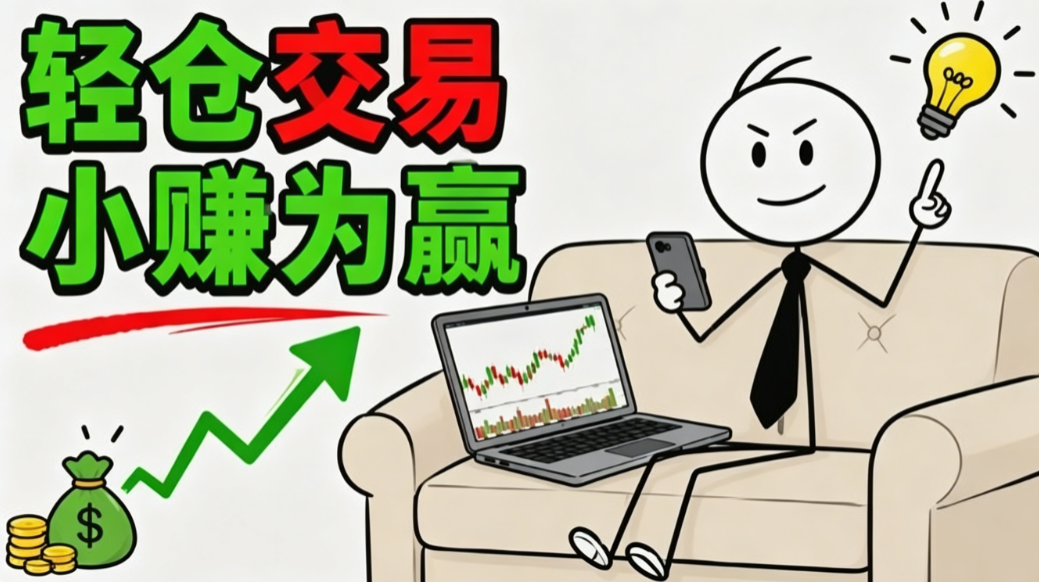
Why is "small position trading" actually more profitable than "large position trading"?
Because the market ruins traders not through "misanalysis," but through "position size."
Most traders fail not because they misjudge. They truly fail because they take oversized positions when they "feel right."
This article will delve into an extremely harsh trading reality: the vast majority of people only truly understand it after experiencing at least one account explosion.
We will analyze in depth why long-term, stable small position trading can protect your profits; Large position trading quietly destroys your account, psychological state, and long-term viability.
This is not theory. This is a true truth about the psychology and mathematics of trading.
It will tell you why aggressive position management will ultimately ruin traders, even if the person is smart and disciplined.
In this article, you will learn:
✔ Why trading psychology is more important than trading strategy.
✔ Why does the size of your position directly control your emotions, discipline, and execution?
✔ Why is "continuous profits" often more dangerous than "continuous losses"?
✔ Behind "this time is different," lies a deadly psychological trap.
✔ Why do professional traders truly care not about "making big profits," but about "surviving"?
We delve deep into the trader's mind: dopamine, fear, self-esteem, confidence...... How these emotions begin to distort your decision-making ability after your position grows.
You will also understand why the vast majority of traders do not fail at the start; It only truly collapsed after they started "trading pretty well."
Whether you trade crypto, futures, forex, or stocks, the rules are the same:
Trading has never been a "right-or-false game."
Trading is essentially a "survival game."
If you want to build a trading mindset that can truly navigate consecutive losses, high-volatility markets, and chaotic market cycles; If you want to truly understand the relationship between risk, positioning, and discipline; Then reading carefully / This article will completely change your understanding of trading.
꒷꒦꒷꒦꒷꒦꒷꒦꒷꒦꒷꒷꒦꒷꒦꒷꒦꒷꒦꒷꒦꒷꒷꒦꒷꒦꒷꒦꒷꒦꒷꒦꒷
If you remember only one moment throughout your trading career, then remember that moment. The moment you start increasing your position isn't because the trading system asks you to do so, but because you "feel" that you're definitely right this time. Not based on probability, not on advantage, but because a dangerous phrase echoes in your mind: "This time is different." ”
And most traders didn't die from a foolish decision. Their true destruction often comes from decisions that sounded "very reasonable" at the time. Your losses are not due to wrong analysis. You lose money because you bet too much on a single judgment that "I must be right."
There are experienced traders in the market, as well as aggressive and bold traders. But at the same time, traders who are both "seasoned" and "bold" are extremely rare. It's not that those who have lived long have become timid, but those who have truly lived in the market for a long time have seen a truth that newcomers haven't yet understood: the market won't punch you to death, nor will it knock you down immediately. It will gently and gently whip you until finally, you break down first and then pull the trigger yourself.
And the most dangerous part is that during the first few "minor blows," you still feel fine. You're still standing, you still have capital, you still have confidence. So, you mistakenly think "you are not dead yet" and "you are on the right path." This is how most traders truly destroy it. It's not about a massive instant liquidation, but rather a series of "sounds reasonable" small decisions, slowly heading toward death.
Many people believe, "Greater risk means greater reward." In real life, this saying sometimes holds true. In the business world, it can also be established. But in trading, this belief ruins more accounts than anything else.
"Place heavier bets, make more money." That phrase sounds incredibly tempting. Very passionate and bold. Like someone who truly dares to "go all out." And your brain instinctively loves this feeling, because it naturally loves bursts, quick rewards, the thrill of making a big win, your heart races, you jump out of your chair, and quietly tell yourself, "I can really do it." ”
But trading is precisely where this instinct can turn into an enemy, because trading is not a "game of right or wrong." Trading is essentially a "survival game"—even if you get 60 out of 100 trades right, if you use the wrong position 12 times, you could still be completely dead.
This is the thing many new traders are most reluctant to accept: you don't need to be "always right" to survive. What you really need is—a loss small enough not to die. But pride doesn't like this phrase. Self-esteem longs for a quick turnaround, longs for a breakthrough, longs to break even as soon as possible. So, radical deals sound "dangerously correct."
It will whisper in your ear: "This form is perfect." "This is a rare opportunity." "Entering with small positions is simply a waste of opportunity." "If we win this order, everything will change."
Then, you start adding a bit of your position. No one immediately increases their position by 5x right from the start. And no one feels like they're doing something crazy. Just one more trick. Only 0.5% more risk. It's simply because "this time it feels especially right."
But it is precisely this "just a little" that becomes the moment when you begin to hand over control to your emotions.
You've probably heard countless times: "Each trade carries only 1%~2% risk." And you have probably thought to yourself: "This is for the faint of heart." "I'm here to make money." "I entered the trade not to be conservative."
I understand that feeling. A 1% risk sounds too boring. The 2% risk is like crawling. It won't make you feel like you're moving fast. It won't give you a story worth showing off. They won't give you beautiful screenshots of profits to post on Moments. It won't give you a strong dopamine boost. It can even make you feel like you're "giving up money you should have earned."
But what aggressive trading will never tell you is that when you amplify risk, you amplify not just potential profits. What you truly amplify is the "emotional sensitivity" of every decision.
Assume you risk 10% per trade. Five consecutive losses—this is perfectly normal in trading. And what happened? Your account is nearly halved.
And this kind of blow never hurts just the money—it directly destroys your mental state. You sit there, staring at your account balance being cut in half. And at that moment, the deal changed.
You no longer think: "How to make money." "How to find advantages."
All you have left in your mind is one sentence: "How can I break even?" ”
And this mindset is extremely dangerous. Because from that moment on, you are no longer a trader. You become someone who desperately wants to get it back.
A person seeking quality trading opportunities and someone eager to break even are two completely different people.
A trader who risks only 1% on each trade and loses five consecutive trades is just a minor scratch. A 5% loss is indeed annoying and frustrating, but they won't fall into a deep pit. They still have the ability to think, remain calm enough, and continue to look for the next opportunity.
One person is striving to "survive," while another still has the right to "keep winning." That's the whole difference.
If you still don't realize how dangerous this is, take a look at the math. Mathematics never cares about appearances; it doesn't care about your feelings.
If you lose 50%, you need to make 100% profit to return to the starting point. Not to get rich, but simply to "no longer lose money."
And if you only lose 5%, you only need to earn another 5% to recover. One person needs a miracle, another just needs a decent week.
This is not philosophy, this is mathematics.
Mathematics, on the other hand, coldly asks you one question: "After this pullback, do you still have enough capital and a stable mental state to press the next trade button?" ”
Most traders don't die from stupidity; they truly fail because they never understand: what the real game of trading is.
Trading is not a game of "who gets more of it." The real contest in trading is: "After a string of losses, who can still survive?" ”
And continuous losses have never been a matter of "will or will it happen." Instead, it's a question of "when" it will happen.
Even if you are excellent. You will still lose five times in a row, still lose seven times in a row, and still experience very bad months.
The only question is: will your risk structure turn this continuous loss into "normal noise," or into a "death sentence"? If you start to feel a bit uncomfortable inside, a bit resistant, or even a voice saying, "But I'm different." "Well, this precisely shows that I hit the crucial point."
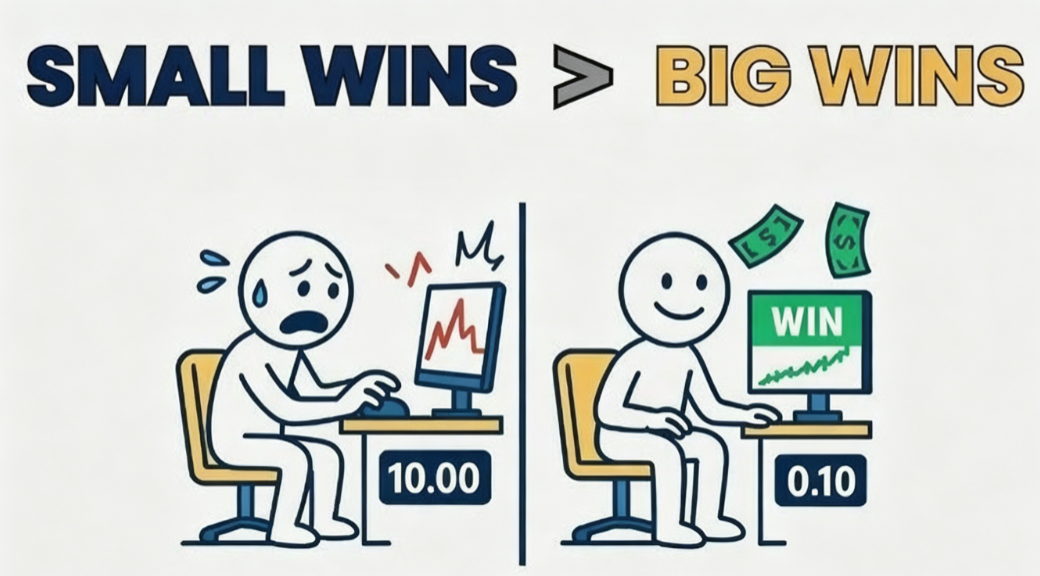
The most dangerous moment for traders is not losing money, but making consecutive profits
In the second part, I'll tell you why the moments traders most likely to die are not when they first start trading, but precisely after they "trade pretty well." And why a period of continuous profits is the most dangerous thing in a trading career.
That's why the most dangerous moment in the trading journey isn't when you open an account for the first time. It's not when you know nothing, nor when you're still afraid to hit the trade button. It's after you've just experienced a streak of profits.
At that moment, your hands no longer tremble. You no longer doubt yourself as you used to. You begin to feel that everything is gradually taking shape. You view charts faster and faster. You find it easier to identify trading patterns. You begin to be able to "predict" the rhythm of the market. Then, deep in your mind, a seemingly harmless thought quietly emerges:
"It seems I really understand."
And it was precisely at this moment that many traders began to slowly head toward death. Not because they had worsened. But because their confidence was growing faster than their disciplined growth. They had not built a strong enough structure to support this ever-expanding confidence.
Continuous profits bring a very dangerous situation: it makes you mistake "probability" for "your own ability."
After you win several trades in a row, your brain doesn't think: "This is statistical probability." "It thinks: "This is me." "I can read the market." "I'm different from everyone else." "I'm no longer an ordinary retail investor."
So, naturally, you start to "negotiate" with risk. Not in an obviously crazy way. But in a way that "sounds very reasonable."
"This form is better than the previous ones."
"The market is very simple today."
"I'm in great shape right now."
"It's okay to add a little position."
You don't break the rules roughly. You will only slowly bend the rules. A 1% risk becomes 2%. A 2% risk becomes 3%. Then, a trade you are "extremely confident" in slowly grows into 5%.
No one will feel like they're "committing suicide" at that moment. On the contrary. You will feel like you are "optimizing."
And here, this is precisely what sets trading apart from all other industries. In most industries, when you get better and better, you're usually allowed to do bigger. But in trading, this is precisely a trap.
Because the market simply doesn't know who you are. It doesn't care if you won 5 or 50 consecutive wins before. It won't reward your confidence. It only cares about one thing: "How much will you lose when you're wrong?" ”
Then, as with the laws of nature, continuous losses will inevitably occur. It's not because you suddenly became stupid. Rather, it's because continuous losses are inevitable.
The problem is: this time, you're no longer just risking 1%. This time, every blow became heavier.
When you first lost money, you were fine. The second stroke started to get a bit restless. On the third stroke, you start telling yourself: "It's okay, it's just a normal drawdown." ”
But by the fourth and fifth strokes, your brain switches modes.
It no longer analyzes.
It begins to "react."
"My life is a failure."
Take this sentence seriously. A man who once earned wealth beyond what most people could even imagine ultimately ended his life with the word "failure." And the reason is simply one issue that many beginner traders often overlook: excessive positions. It's not a strategy, not an analysis, not a trading pattern, but rather — position size.
If you think, "That's just the story of a legendary person, it has nothing to do with ordinary retail investors like me." "So I can tell you directly, retail investors are dying even faster. Because retail investors have no unlimited funds, no credit limits, no support teams, and no ability to withstand huge drawdowns. And this is what happens in aggressive trading.
You are heavily invested in trades. Then you win. Your brain is instantly flooded with dopamine. The feeling was unbelievably good. You're not just happy. You seem like you're "hooked." You feel smarter than yesterday. You feel ahead of the market. You start thinking, "If this continues, I'll succeed quickly." ”
So, your brain starts craving to repeat that feeling. So when you make your next trade, you'll open a larger position. It's not because strategy demands you do it. It's because—you want to experience that feeling again.
"Why not?"
"Didn't I just prove I could do it?"
Then, you lose money. And it's not just a small loss, but a big loss matching the "large position." And the pain of losses is always more intense than the joy of profits at the same level. So, you fall into a deep pit.
And your brain starts sending a primal command: "Earn your money right now!" ”
At this point, you can no longer think clearly. You can no longer maintain patience. You have only one goal left in your mind: "Break even." ”
Then, you further increase your position. Because you start to believe: "As long as you get one right move, you can earn it all back." ”
This is called a "revenge deal." And this is how the vast majority of accounts truly die. It's not because of poor strategy. It's not because of weak analytical skills. Instead, it was because of the large position that triggered emotional decisions.
And safe trading will save you from this nightmare. When you risk only 1% per trade, your emotional response is greatly reduced. A single loss may only annoy you, but it won't destroy you. You won't fall into an emotional spiral. A single profit will make you happy, but it won't make you "so excited you lose your mind" that it affects your next trade.
You can still stay clear-headed. You can still maintain logic. And in trading, "logic is everything." The market simply doesn't care about your mood. But emotions will determine every choice you make.
Here, there is a deeper, yet very few people want to face: even if you have an excellent trading system, as long as your position is too large, you still cannot execute it like a normal person.
You will pray. You will imagine. You will beg the market. You move your stop loss because you can't afford to lose money. You will take profits early because you need a bit of "breathing." You will miss a trading opportunity that was originally perfect, because you just lost and start to feel afraid.
Then, you start blaming the strategy: "This system is basically useless." ”
But the real issue is not a strategic error. Instead, you have turned yourself into someone "emotionally unstable to the point of being unable to implement the system."
When you are no longer "executing" but only "reacting," no system can save you.
To prove this is not just a legendary story, let me share a very real case with you. I used to be in a trading community. There was a trader there with a starting capital of $50,000. He is very skilled at identifying trading patterns and is not a beginner. Two months ago, he made a fortune. The account directly rose to $71,000.
Then, self-esteem appeared.
He started posting screenshots of his earnings every day. Start by saying something like: "I already understand the market." ”
Later, he raised the risk per transaction to 8%. Then, he experienced a string of losses. Lost five times in a row. This is perfectly normal in a transaction. The account dropped directly back to $45,000.
And the truly ugly part starts here.
He panicked.
He said he had to earn his money back.
So, he increased the risk per transaction to 15%. Then, he lost three more transactions in a row. The account dropped directly to $26,000. Complete collapse.
Later, he started doing transactions that didn't even belong to the system. Single-order risk increases to 25%. Completely emotional trading. Starting from a high of $71,000, just six weeks later, the account balance dropped below $3,000.
And his last words were: "Trading is simply not suitable for retail investors." ”
Then, he disappeared.
And the most frustrating part is that he is not a bad trader. His trading pattern is good. His analytical skills are also quite good. But once you enter the "death spiral," everything else no longer matters.
Large positions entered.
Major losses.
To break even, they open larger positions.
Then, catastrophic losses.
And safe-haven traders never enter that spiral. It's not that they're stronger. It's because they never endure a blow that can cause panic in the first blow.
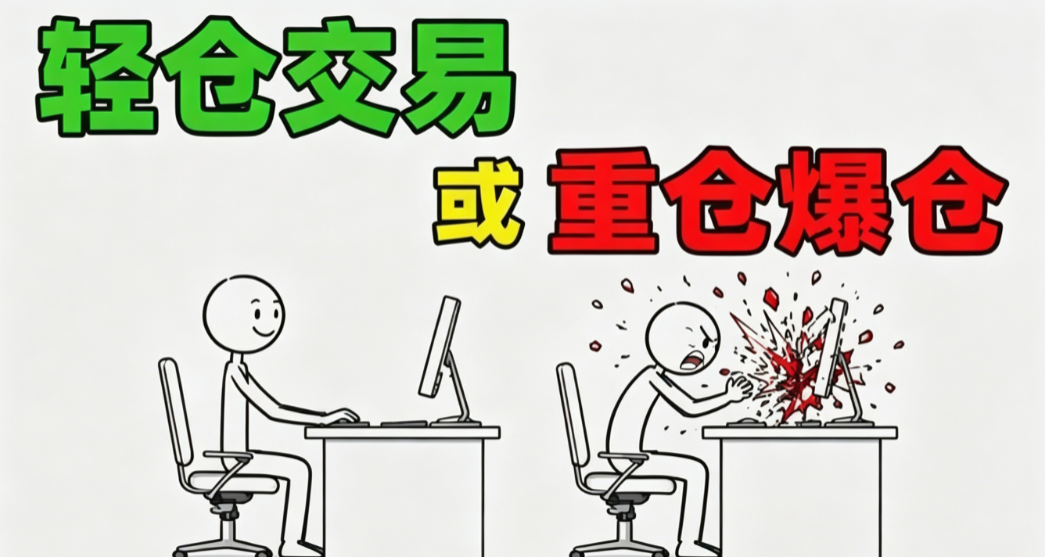
Volatility has never killed those who misjudge the market, but those who hold oversized positions
In Part Four, I'll take you back to that moment when the entire market was in a frenzy: March 2020. Let me tell you why volatility always prioritizes killing aggressive traders. And why only those who survive are qualified to earn money that rebounds later.
If you think the previous stories are just "isolated cases," merely "human errors," So, let's look at that moment when global traders collectively had their dignity crushed by the market.
March 2020. The outbreak of the pandemic. The entire market went completely crazy.
This is not an ordinary pullback, nor a simple drop—it's genuine panic.
Stocks plunged 20% or 30% within days, with some even dropping 40%. Fuses are triggered again and again. The VIX Fear Index surged to a level not seen since the 2008 financial crisis. Price fluctuations are faster than any of your "nice stop-losses." Huge slip point. Gap gap. All technical structures were directly torn apart.
And it was at this moment — mathematics began to "devour" humanity.
If you risk 10% on each trade and you happen to be in the wrong direction, What you lose might not even be 10%. Instead, it's 20%, 30%, even 40%. And it may only take a few hours. It's not about losing a single position. Instead, the entire account was destroyed.
Because stop-losses are directly penetrated. Because no one is taking over the market at all. Because liquidity disappears instantly. When you click close position, there's no one else on the other side.
And this is something most beginners never consider: risk is never linear.
Under normal market conditions, 1R is 1R. But in panic markets, 1R can instantly turn into 3R or 5R. Large positions can directly amplify all of this into disaster.
A trader who only risks 1% per trade will also get hurt in such a market. Don't get me wrong. They will lose money and suffer just the same pain, but if the market goes 30% in the opposite direction and your position is only 1%, your account might lose just 3%. It hurts, but you are still alive.
The most brutal part is that the crash did not last for many years. It usually lasts only about a month, or about six weeks. Then, the market began to rebound wildly. And the rebound speed is extremely fast.
If you survive the first crash, the rebound opportunities later will be enormous.
Safe-haven traders survived. And in the subsequent rebound, they made a lot of money. And aggressive traders have long since disappeared. Account crashed. Mental breakdown. All I can do is sit there and watch others make money again.
Then he desperately wondered: "Where should I gather another sum of principal?" ”
Volatility doesn't matter how confident you are. It doesn't care how strong your analysis is. It will only swallow aggressive, large-position traders like breakfast.
And here, I want to pause and think. The market doesn't need you to be right right away; it only needs you to make one mistake when you're heavily invested.
Most traders only realize an uncomfortable truth after paying the price: trading ruins you not because you are foolish, but because you start to feel smarter than the market.
And the most dangerous moment is not when you first start trading. It's after you've just experienced a period of continuous profit.
At that moment, you start to feel different from others.
At that point, you start to feel that the "1% risk rule" is just for others.
That's when you start "negotiating" with risk.
"Just this once."
"This form is absolutely perfect."
"Today's market is simple. As long as I win one more order, I'll be back on track. ”
No one will be forced to liquidate out of panic at the start. When people truly liquidate their positions, it is often in a state of "false confidence." That's why so many traders die precisely after "trading starts to go smoothly." Not because things worsened, but because—before they improved discipline, they increased their positions.
Deep down, professional traders fear a concept: "Probability of liquidation." "In other words, the probability of being completely kicked out of the game by the market. You don't need to reset your account to be truly destroyed. You only need to fall to a certain point: your mental state can no longer function properly. By then, you would have already been out.
A loss of 40%~50% in the account is already fatal enough. It's not because you have no money, but because you no longer dare to press the trade button. You start to hesitate. You start taking profits early. You start moving your stop-loss. You start to lose faith in yourself. The account may still be there, but the trader is dead. And once the trader dies, the money in the account is only a matter of time.
Professional traders never ask, "If I make money from this trade, how much can I make?" What they really ask is: "If I lose this order, how much will I lose?" "And after losing everything, can I still maintain a normal state and keep trading?" This is the question that someone who truly wants to live long-term will ask.
If you still feel: "I can trade large positions for a while and then reduce risk later." "Then you should carefully consider the real cost of a single big loss. It's not just money, but time.
Time to recover. Time to rebuild confidence. Dare to calmly press the trade button again at the time. And during that time, the market won't stop waiting for you. The major cycle is still running. A major rally will still occur. And only those who still have funds, a stable mindset, and discipline are qualified to participate.

You don't need to make big profits; what you really need is small losses
In Part Five, I will end it all with a very simple but extremely hard truth to truly accept: you don't need to "make big profits"; what you truly need is "small losses."
I will also give you a very specific ritual. A checklist with only 10 items. Before you hit the trade button, cut off your emotions completely.
Now, after hearing all the stories, all the data, all the crashes, all the accounts that disappeared, let's return to the simplest truth: you don't need to make big money. You need a small loss. Not for the sake of conservatism. Not just for fun. It's about living long enough so your trading edge truly starts to work.
Trading does not reward the smartest people. The deepest analysts will not be rewarded. It does not reward the person who makes the best trade. The real reward for trading is the person who, after a string of losses, still sits at the table.
Here, there is a paradox that most traders take years and sacrifices to truly understand: profit does not come from "getting it right more times."
Profit really comes from "when you're wrong, you didn't kill yourself." ”
The real winner is not the one who dares to gamble. But rather, when waiting for an opportunity, they still have enough discipline and don't break the rules.
You could never have a "legendary trade" in your lifetime. It's okay. You don't need it at all. What you really need is that not a single one out of 1,000 transactions is qualified to ruin you.
And once you truly understand this, the trading process starts to change. You no longer hold illusions. No more prayers. No longer staring at the chart, sweating profusely. You don't move your stop loss because you can afford to lose money. You won't take profits early, because you don't need to catch your breath by "cashing in quickly." You won't be afraid to miss a trade, because you know the market will always give you more opportunities.
Trading gradually shifts from "emotion" to "professionalism."
And this profession actually has only one requirement: don't commit suicide.
And to do that, you need something very boring. Not a strategy. Not a measure. Not form. It's the ritual.
A ritual that cuts off emotions before you press the trade button. Not to appear professional. Instead, it's to protect yourself from harm to "yourself."
Below is this checklist. Not just silently repeating in your mind. Instead, read it aloud. If you haven't finished reading. Then you won't be allowed to enter. No exceptions.
Pre-trade checklist:
First, how much risk will this trade take on my account? Is it exceeding 1%~2%?
Second, if this order loses money, can I still stay calm?
Third, is this stop-loss set based on technical logic, or is it because I can't bear the feeling of a bigger loss?
Fourth, am I entering now because the trading pattern is valid, or because I want to make money back?
Fifth, does this trade fit the plan I wrote in advance?
Sixth, if I lose this money, can I avoid complaining, getting angry, or seeking revenge?
Seventh, if this order loses money, can I remain clear-headed enough to execute the next trade correctly?
Eighth, am I increasing my position now? Why?
Ninth, am I too anxious right now? If I miss this deal, will my life really collapse?
Tenth, I am entering the market now to implement the system, or to prove "who I am"?
If any of these issues make you uncomfortable—you are not allowed to enter. This is not a limitation. This is the seat belt.
Then, as time goes by, something very strange begins to happen. Every trade you execute according to the rules gradually builds your confidence. Not because you made money. It's because you start to become "trustworthy."
You are building a "disciplinary record." You are proving to yourself: even under pressure, you will not betray yourself. But what aggressive traders have set is a different kind of record: a record of panic. A record of fantasy. A record of regret.
Even if they make money, what they reinforce remains a bad habit. Their profitable trades are under pressure. So the next trade is also full of pressure. This cycle will never stop.
A few months later, years later. The psychological gap between these two types of traders becomes enormous.
A type of person who is calm, steady, and truly confident. Another type is anxious, impulsive, and emotionally unstable. The same market, the same opportunities, yet a completely different life experience.
Now, remember Warren Buffett's two famous rules:
Rule 1: Never lose money.
Second: Never forget the first point.
Warren Buffett is wealthy not because he is always right. But because he was never kicked out of the game.
Trading is the same.
You don't have to be right all the time. What you really need is to stay alive all the time.
Because the real winner is not the one who trades the most beautifully. But rather, the one who, while waiting for an opportunity, still maintains enough discipline and does not destroy himself.
If you are still stuck in that attitude: "Buy a little heavier, succeed quickly." "The feeling of being tempted."
So, please slowly ask yourself a question:
What do you want to become, is it "the trader who gets right only once"? Or "the trader who's still alive after 1,000 experiences"?
The market will always give you another chance. The premise is that when the opportunity comes, you are still alive.