
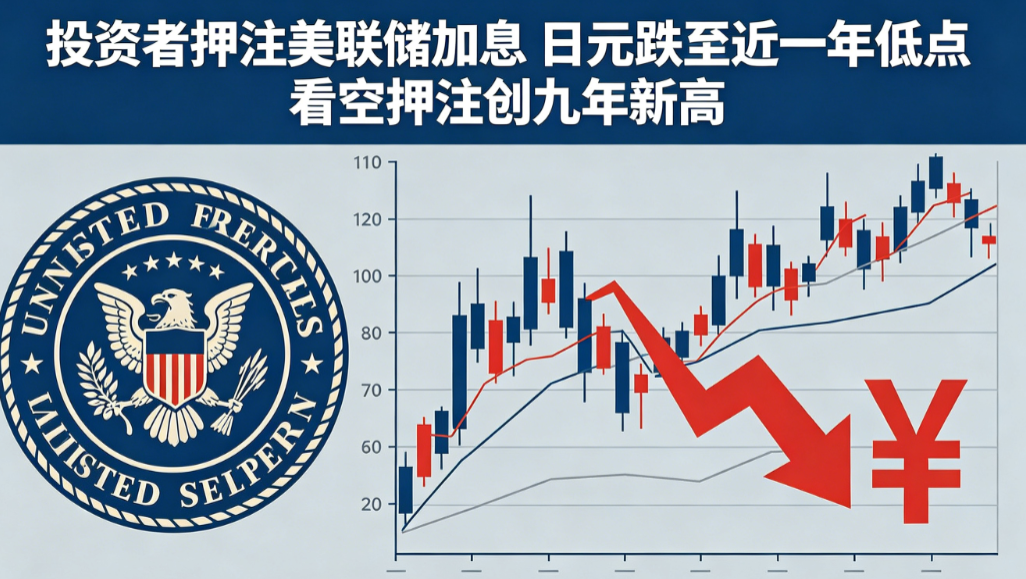
Rising Fed hike expectations plus a wide US-Japan rate spread push the yen back toward a key line of defense
Keywords: yen weakness, Fed rate hikes, Bank of Japan, FX intervention, US-Japan rate spread, carry trade, energy prices, foreign exchange market
Introduction
Recently, the international FX market has again focused on the yen. As expectations grew that the Fed may raise rates again later this year, the yen fell to a near one-year low against the dollar on Wednesday, touching 160.79 per dollar intraday and prompting wide speculation that the Japanese government may step in to intervene again. At the same time, the dollar has remained broadly strong, most non-U.S. currencies have come under pressure, and the yen has continued to hover in a fragile zone under multiple headwinds.
On the surface, this is an exchange-rate move; at a deeper level, it reflects global monetary policy divergence, energy-price shocks, Japan's domestic dilemma of balancing inflation and growth, and the market's reassessment of policy tools. For Japan, a persistently weaker yen does not just mean higher import costs and lower household purchasing power; it may also force a harder choice between stabilizing the currency and supporting the economy.
1. A strong dollar and the US-Japan rate spread remain the main drag on the yen
The most direct reason for the yen's weakness is still the strong dollar and a wide US-Japan rate spread. As the market keeps betting that the Fed will tighten again later this year, expectations for short-term U.S. rates remain elevated, and capital naturally prefers dollar assets. A stronger dollar not only boosts the appeal of the dollar itself, but also weakens low-yield currencies such as the yen.
For the FX market, rate expectations often matter more than current rates. Even though the Bank of Japan announced a rate hike on Tuesday, markets still broadly believe its tightening pace will be modest and will not quickly reverse the huge gap between Japan and the United States. In other words, while the BOJ has begun to move away from ultra-easy policy, its stance still looks clearly dovish versus the Fed, leaving the yen without a solid basis for sustained recovery.
BOJ Deputy Governor Shinichi Uchida's remarks after the decision also made that clear. He stressed that exchange-rate moves have an important impact on the economy and prices, but they are not a direct target of BOJ monetary policy. That means the BOJ will not sharply accelerate rate hikes simply to stabilize the yen; its policy focus remains domestic growth, prices and wage gains.
2. The BOJ's hike was limited, so it is unlikely to change market expectations
From the market's response, the BOJ's latest hike did not effectively reverse the yen's downward trend. The reason is that although the hike was symbolically important and marked a gradual normalization of Japanese monetary policy, its size and pace are still too small to alter the view that the yen will remain weak for some time.
First, Japan's inflation is above the long-running low-inflation era, but its drivers differ from those in Europe and the U.S. Japan's price pressure comes more from import costs, energy prices and exchange-rate moves than from strong domestic demand. So a rate hike alone may not curb imported inflation effectively, while it could still restrain already fragile consumption and business investment.
Second, Japan's economy has depended on low rates for many years, and the financial system and corporate sector have limited tolerance for higher funding costs. If the BOJ tightens too quickly, it could hurt the recovery and amplify worries about growth. That is why the BOJ remains cautious, and that caution signals to FX traders that it may not provide enough support for the currency.
Third, compared with Japan, the U.S. economy and labor data remain resilient, leaving the Fed room to keep rates high or hike again. On one side is Japan's slow normalization; on the other is the possibility of further U.S. rate increases. That means the US-Japan rate spread is likely to stay elevated for a while. If the spread does not change, the yen's weakness is hard to reverse fundamentally.
3. Repeated government intervention can ease pressure in the short run, but not fix the root cause
It is worth noting that this yen slide comes right after a large-scale FX intervention by the Japanese government. Data show that between April 28 and May 27, Japan spent a total of 11.73 trillion yen, or about $73.6 billion, setting a record high. Such a huge intervention shows how seriously the government views rapid yen depreciation.
Operationally, FX intervention can indeed change sentiment in the short term, especially when speculative positions are heavily concentrated and market liquidity is weak. A coordinated policy move can act as a strong deterrent. However, intervention's effectiveness usually depends on two conditions: whether the fundamentals cooperate and whether it is part of a broader policy package.
If the rate spread keeps widening, the dollar stays strong and Japan cannot quickly achieve a more obvious policy tightening, then intervention alone can usually only delay, not reverse, the trend. In other words, intervention can slow the move, but it cannot easily change its direction.
The market keeps guessing that the government may step in again because the yen is already near, or even at, a level that authorities find hard to tolerate. Especially around the 160 round number, the market is usually more sensitive to policy response. Once the exchange rate breaks a key psychological level and keeps weakening, the odds of official intervention rise sharply.
4. Rising energy prices worsen Japan's import burden and boost dollar demand
Beyond the rate-spread factor, higher energy prices are another important reason for the yen's weakness. Japan is highly dependent on crude oil imports, and international oil is usually priced in dollars. When oil rises, Japanese importers need to pay more dollars to buy energy, which directly increases FX market demand for dollars and widens Japan's trade and current-account pressure.
More importantly, higher energy prices feed into domestic inflation through import costs. For an energy net importer like Japan, higher oil prices do not just raise business costs; they also squeeze household disposable income and hurt the consumer recovery. A weaker yen plus higher oil prices can create a negative feedback loop between imported inflation and currency depreciation.
Although the United States and Iran recently reached a temporary accord, agreeing to restart shipping through the Strait of Hormuz and push forward a ceasefire process, risk appetite improved only modestly and did not materially change the yen's performance. The reason is that oil matters, but it is not the decisive variable; policy expectations and capital flows still dominate the currency direction.
5. The return of carry trades shows the market is repricing yen weakness
One worrying sign in the market is that speculative bets against the yen have risen to the highest level in nine years. That suggests traders are rebuilding the classic 'yen carry trade' pattern: borrowing cheap yen and investing in higher-yielding assets.
At its core, a carry trade means borrowing a low-cost currency and buying higher-yielding assets to capture the spread. Japan's long period of ultra-low rates has naturally made the yen a funding currency; when rates in the U.S. and elsewhere are high, yen funding is more likely to be sold and moved into higher-yielding assets. Once that trade becomes large-scale, it tends to intensify yen weakness and reinforce itself through market expectations.
That is also why the yen often falls fast but rebounds slowly. Once the market forms a one-way view, capital trades with that momentum rather than waiting for fundamentals to improve. Elevated speculative positions mean traders already have a strong consensus that the yen will keep weakening, and any short-term bounce could face heavy selling pressure.
6. The 160 level is more than a number; it is a dividing line for policy and confidence
From a technical and psychological perspective, 160 yen per dollar is a crucial dividing line. Market participants widely believe that if the yen falls further below 160 and keeps weakening, pressure on the Japanese government to intervene will rise sharply. Touching 160.79 intraday shows the market is already close to this sensitive zone.
Even more important is that the next key level to watch after 160.79 is around 161.95. If that level breaks, the yen would fall to its lowest point since December 1986, with a powerful historical implication. That would not only deepen the market's view that the yen is weak for the long term, but also tempt speculators to test policy limits further.
For policymakers, breaking a key round number is not just a market issue; it also affects public confidence, import costs, corporate expectations and international image. If the market reads the depreciation as 'bottomless', intervention costs will rise and policy effectiveness will weaken. So the battle around 160 is really a struggle between market expectations and policy deterrence.
Conclusion
Overall, the yen's weakness is not caused by a single factor. It is the result of the Fed's rate-hike expectations, a wide US-Japan rate spread, limited BOJ tightening, rising energy prices and the return of carry trades. The Japanese government has already intervened on a large scale, but if the fundamentals do not change, intervention is more likely to provide short-term stabilization than to reverse the trend.
Over the next period, the yen will still depend heavily on three variables: whether the Fed keeps tightening as expected, whether the BOJ accelerates normalization, and whether the Japanese government intervenes again at key levels. If the dollar remains strong and the yen cannot gain stronger policy support, the tug-of-war around 160 is likely just a stage in a larger move.
For markets, the yen is not just an exchange-rate number. It is a snapshot of global monetary-policy divergence, capital flows and geopolitical energy risk. For Japan, finding a more sustainable balance between currency stability, price stability and growth will be the core policy challenge ahead.