
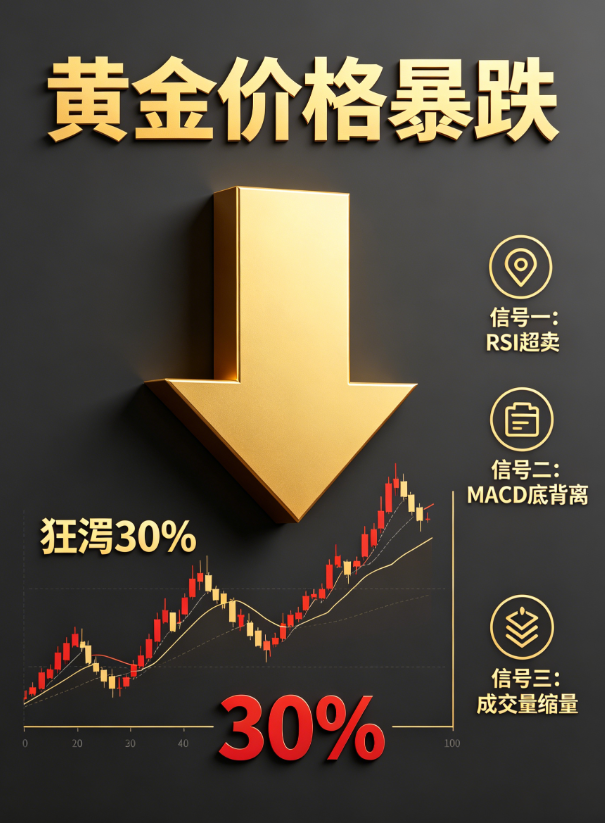
After gold's sharp nearly 30% drop, where is the bottom?
Keywords: gold prices, central bank gold buying, rate-hike expectations, liquidity selling, gold ETF, asset allocation
Introduction
Gold, which kept setting new record highs early in the year, has suffered a violent correction in just a few months, with a maximum drop of nearly 30%. From the narrative of de-dollarization to continued central-bank buying, gold was once seen as one of the most certain assets. Yet in 2026, prices suddenly reversed from the top, catching many investors off guard. Why did gold suddenly fall apart? Is this a trend reversal, or a deep pullback within a bull market? From the market's logic, the answer is closer to the latter.
Multiple bearish forces hit in sequence, bringing gold back from euphoria to reality
This round of gold correction was not driven by a single factor, but by several bearish forces being priced in one after another. First, the core narratives that supported gold's rise - geopolitical conflict, weakening dollar credibility and rising global safe-haven demand - had already been heavily traded at elevated levels, leaving sentiment overextended. Then sudden conflicts and risk events tightened liquidity, and gold saw the classic 'sell first to raise cash' behavior under extreme stress, a natural response under pressure testing.
More importantly, macro expectations began to work against gold. Rising oil prices increased inflation worries, and the market's expectations for Fed rate hikes later in the year rose accordingly, weakening the easing logic that had supported gold. At the same time, stronger U.S. labor and economic data further reinforced the idea of tighter policy. For gold, once the positives were fully priced and the negatives kept arriving, a high-level pullback became hard to avoid.
Gold has not 'lost' its safe-haven role; the funding structure has changed
There has been growing talk that gold's safe-haven role is failing, but that does not mean its long-term value has disappeared. Gold is still an asset with both commodity and financial characteristics, and being sold for liquidity in an extreme shock does not mean its hedging function is permanently gone. After the 2008 financial crisis and the 2020 pandemic shock, gold also fell sharply in the short run and then recovered quickly. That pattern has not changed.
What matters more is the change in funding structure. Over the past two years, central-bank buying formed the floor for gold's rise, while in 2025 allocation funds and ETF flows poured in heavily, gradually turning gold from a traditional safe haven into a crowded trade. Once 'safe haven' itself becomes a popular allocation theme, gold behaves more like a risk asset when it falls. That can magnify short-term drawdowns without overturning the long-term support logic.
$4,000-$4,200/oz: a key bottom zone to watch
From a supply-and-demand perspective, the main support for gold still comes from central-bank buying. In recent years, central banks worldwide have kept adding gold, making it a structural trend; even if the pace slows for a while, it is enough to provide a floor. Meanwhile, continued net outflows from ETFs mean short-term selling pressure is still being released, but once those outflows near an end, the market is often close to a phase bottom.
All told, the $4,000-$4,200/oz range looks like the key zone to build positions in this correction. The reason is simple: first, the long-term logic has not been broken; second, negative factors such as oil prices, inflation and rate-hike expectations have already been priced fairly fully; third, equity markets often sense the bottom first, and a stop in gold-miner stocks is usually an important clue. Even if gold rebounds and then retests lower, the downside should likely be limited.
Conclusion
Overall, this gold plunge looks more like a technical washout after a crowded rally than the end of a bull market. For long-term investors, the real question is not short-term volatility, but whether the underlying logic supporting gold's rise has changed. As long as central-bank buying, de-dollarization and asset reallocation trends remain in place, gold's long-term value still holds. For ordinary investors, the safest strategy is not to chase rallies or sell into panic, but to scale in against the trend when prices have corrected enough and pessimism is intense. Gold opportunities are often born when the market feels most uneasy.