Fed 'hawkish debut' sparks a huge gold swing: the Warsh era begins, so why did prices suddenly plunge?
Keywords: gold prices, Fed rate decision, dot plot, US dollar index, geopolitics, inflation expectations, Warsh, rate-hike expectations
Introduction
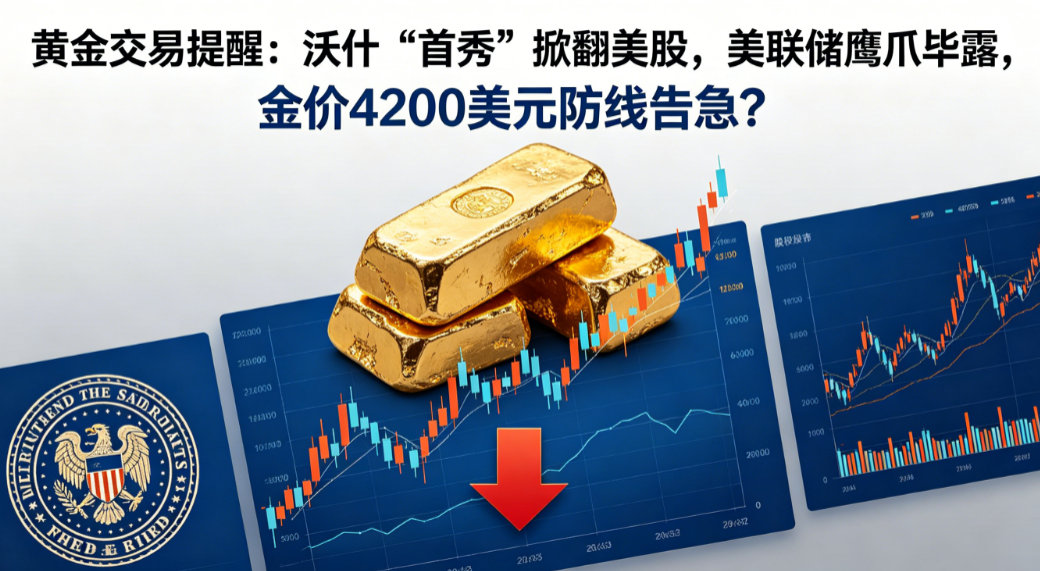
On Thursday, global gold markets staged a classic roller-coaster. Earlier, spot gold had been holding steadily above $4,330/oz, with a cumulative gain of more than 6% over four trading days, and the market was broadly in an upbeat mood. But the Fed's latest rate decision and new Chair Kevin Warsh's first public appearance quickly reversed that tone. Gold plunged more than 2% intraday, briefly touching $4,219/oz, before settling at $4,257.60, down 1.7% on the day.
On the surface, this looked like a routine rate meeting; in reality, the policy signal it sent, the shift in communication style and the repricing of expectations formed the core logic behind the gold selloff. More importantly, this adjustment was not an isolated event, but the result of multiple forces from macroeconomics, monetary policy and geopolitics moving together.
1. Rates held steady; the real shock came from the dot plot
The Fed left its policy rate unchanged in the 3.50%-3.75% range, keeping it steady for a fourth straight meeting. That decision itself was not a surprise. The U.S. labor market remains resilient, unemployment is still relatively low at 4.3%, and inflation is clearly above the 2% target. Against that backdrop, the market had already expected the Fed would not rush to cut rates.
The real trigger for the violent move was the Summary of Economic Projections, especially the closely watched dot plot. The latest data showed that of the 19 policymakers, nine now leaned toward the need to raise rates this year, while only one favored a cut. That was sharply different from the previously expected median path and signaled a clear hawkish shift inside the Fed.
Even more notable, six of those nine officials who supported hikes expected at least two increases. Markets quickly repriced: CME FedWatch showed the probability of a December hike jumped from 61% before the decision to 83%, and short-term rate futures even suggested the Fed could restart hikes as early as September.
That means the narrative that gold had relied on - that rates had peaked - is being broken. Gold is fundamentally a non-yielding asset, so when the market starts pricing in a higher rate path and stronger real yields, its appeal naturally falls. Independent metals trader Tai Wong summed it up well: the statement and dot plot were both hawkish, and the new chair did not step in to soften that bias, so the market quickly chose to pull back.
2. Warsh's first appearance sent a signal: communication changed, policy room narrowed
If the dot plot was the immediate trigger for the decline, Warsh's first meeting amplified the bearish mood.
First, he pushed for a consensus and released a sharply shortened policy statement. Compared with the Fed's recent style of lengthy, detailed language that emphasized forward guidance, this statement returned to a much more concise form, with word count cut sharply and no clear hint about the future policy path. This was not just a wording change; it suggested the Fed is weakening its pre-commitment and increasing policy flexibility.
Thomas Simons, chief U.S. economist at Jefferies, said the change matters. After the global financial crisis, the Fed increasingly stressed transparency and guidance management. Now it is moving closer to the Greenspan era, with less explicit guidance and more discretion. For markets, that means more uncertainty; for gold, uncertainty is usually supportive over the long run, but in the short run, if the policy stance feels tougher, safe-haven assets often pull back first.
Warsh also left no room for dovish fantasies in his press conference. He said plainly that he could not tell the market what comes next, only that there would be another meeting in six weeks. He also warned investors not to overread the dot plot, calling those forecasts 'written in pencil'. But markets often interpret that kind of remark as meaning the Fed is not eager to calm markets and is willing to let rate expectations work themselves out.
Even more striking, Warsh announced a full review of the balance sheet, policy communication, data sources, productivity, employment and the inflation framework. That shows he is not content to simply continue the old path; he wants to reshape the Fed's policy framework and operating style. From the market's perspective, that reform drive means the Fed may become more pragmatic, but also harder to predict.
Especially with inflation still above target, Warsh stressed twice that 'rates are only restrictive in housing', which the market read as a stance clearly tougher than his predecessor Jerome Powell's. In other words, the Fed under his leadership is more likely to prioritize suppressing inflation than protecting asset prices.
3. The U.S.-Iran accord cooled tensions for now, but geopolitical risk has not disappeared
Before the Fed decision, gold's four-day climb was also closely tied to a marginal easing in geopolitical risk. The U.S. and Iran reached a ceasefire memorandum of understanding, which briefly pushed down international oil prices and eased worries about energy-driven inflation. Against that backdrop, gold's appeal as an inflation hedge improved, funds rushed back in, and gold rose more than 6% over four trading days.
Logically, the gold rally in that phase is easy to understand: lower oil prices mean less inflation pressure, and if the market expects the Fed to slow its hiking pace, gold benefits from both falling inflation and lower real rates.
But the accord itself was clearly temporary in nature. The document was only about a page and a half, under 800 words, and many key details were left for technical negotiations over the next 60 days. In other words, this was not a final settlement of the conflict, but rather a framework that temporarily froze risk.
Trump later said that if he was unhappy with the agreement, war could resume. That comment shows the so-called 'peace dividend' is unstable; geopolitical risk has only been compressed for now, not eliminated. That is why gold, despite tumbling on the Fed's hawkish signal, still found some downside limit. The market knows that as long as the Middle East remains uncertain, gold's safe-haven role does not disappear entirely.
4. Dollar, yields and stocks: the outside forces behind gold's fall
Gold's plunge was not driven by a single variable, but by a combination of a stronger dollar, rising yields and pressure across risk assets. After the decision, the dollar index rose 0.8% to 100.38. For dollar-priced gold, a stronger dollar makes it more expensive for overseas buyers, naturally dampening demand.
At the same time, U.S. Treasury yields moved sharply higher. The two-year yield jumped 17 basis points to 4.216%, its highest since February 2025; the 10-year yield also rose to 4.495%. That shows the market is repricing the future tightening path, and higher real rates are putting direct pressure on gold.
Stocks were not spared either. The S&P 500, Nasdaq and Dow all closed lower, all 11 major sectors fell, and the VIX posted its biggest one-day gain in four days. Risk appetite clearly weakened, funds rotated toward higher-liquidity and higher-yielding assets, and gold was sold in the short term.
It is worth noting that the impact of higher rates is not uniform across sectors. Regional banks and real estate were hit first, with the KBW regional banking index and the homebuilders ETF both weakening noticeably. That also shows the market is re-evaluating the broader impact of a higher-rate environment on the real economy and asset prices.
5. Gold outlook: under short-term pressure, but the long-term logic is intact
In the short term, gold does face correction pressure. Higher rate expectations, a stronger dollar and rising real yields all weigh on performance. Especially as the market begins to trade a 'higher for longer' path again, the appeal of gold as a non-interest-bearing asset will likely weaken for a while.
But over the longer term, gold's core support has not disappeared. First, the trend of central banks buying gold continues, providing structural demand. Second, geopolitical uncertainty has eased only temporarily thanks to the U.S.-Iran accord; conflict risk across the globe has not gone away. Third, if economic data weakens or inflation falls faster than expected, the Fed's hawkish stance could soften again, and gold could regain favor.
So the more reasonable view is not to simply turn bearish on gold, but to see it entering a period of high volatility and sharp divergence. For investors, the key is not chasing short-term sentiment, but watching the dollar index, real yields, the Fed's follow-up remarks and developments in the Middle East. Building positions in stages during volatility may be more strategic than chasing highs or panic selling.
Conclusion
This round of gold's plunge is essentially the result of a repricing of Fed policy expectations, and also the market's immediate reaction to new Chair Warsh's hawkish debut. The dot plot, policy statement and press conference together changed investors' understanding of the future rate path, triggering a chain reaction of a stronger dollar, higher yields and lower gold.
But over a longer horizon, gold has not lost its allocation value. As long as the global economy still faces multiple disturbances from inflation, geopolitics and policy uncertainty, gold remains a key part of any portfolio. In the short term, it may be under pressure; over the long term, it is still one of the market's most important safe-haven tools.
Warsh's Fed is redefining monetary policy in a more decisive, more pragmatic and also more hawkish way. That poses a direct challenge to gold, but it also reminds markets that the real risk is often not volatility itself, but misreading the new cycle.