
Home
Gold & Silver Live Prices
Gold Jewelry Jumps 63 Yuan/Gram in a Day! International Gold Price Returns to $4300: How Far Can the "Three Main Drivers" of Market Recovery Push It?
Gold Jewelry Jumps 63 Yuan/Gram in a Day! International Gold Price Returns to $4300: How Far Can the "Three Main Drivers" of Market Recovery Push It?
On August 5th and 6th, the international gold price surged over 4% in a single day, returning above $4300 and setting a new high since June 18th. Domestic gold jewelry prices jumped by 55 to 63 yuan/gram in a single day, which is 4 to 10 times the usual fluctuation. Three major drivers were the unexpected US ADP employment data, the rising expectation of shipping through the Strait of Hormuz, and the Bank of Korea's first gold purchase in 13 years. The article deconstructs the market trend logic

This article is for informational purposes only and does not constitute any investment advice. Precious metals trading involves risk, please make decisions carefully.
On August 6th, the international precious metals market continued its overnight surge, with spot gold breaking through the $4300/ounce mark during trading, for the first time since June 18th. Domestic brand gold jewelry retail prices "followed suit," with brands such as Laomiao Gold and Zhou Sheng Sheng reporting daily price increases of 58 to 63 RMB/gram, which was 4 to 10 times the normal daily fluctuation. This rebound, fueled by the combination of weak US employment data, expectations of easing Middle East tensions, and central bank gold purchases, is it a "recovery after a setback" or the start of a new bull market? Market divergence is increasing.
I. 4% Overnight Surge: Gold and Silver Hit New Peaks
Market data shows that London spot gold closed up 4.16% on August 5th at $4247.17/ounce, setting a new high since February 2026 for the daily gain. London spot silver also rose by 4.26%, surpassing $62/ounce and approaching a seven-week high. The main New York gold contract rose by 4.2% in a single day, closing at $4308/ounce. Domestic precious metal futures, including Shanghai gold, Shanghai silver, Shanghai platinum, and Shanghai palladium, also strengthened collectively, with the Shanghai silver 2610 contract surging by 6.53% at one point, and platinum and palladium futures rising by over 8.6% and 7.7% respectively. As of the Asian session on August 6th, the spot gold price continued to rise, with a daily gain exceeding 1% at one point, peaking near the $4295 level, before trading in a tug-of-war around $4300.
II. The Dance of the "Three Drivers": From ADP Disappointment to Hormuz Expectations
Based on multiple institutional and industry views, this round of gold price rebound is mainly driven by the resonance of three forces.
Driver One: Significant Cooling in US Employment Data
The US ADP private sector employment report showed that July saw only a 44,000 increase in employment, far below the market expectation of 70,000, and a noticeable decline from the previous figure of 98,000. The cooling job market directly suppressed market bets on further interest rate hikes by the Federal Reserve in September, leading to a decrease in the expected holding cost of gold as a non-interest-bearing asset, providing the most direct upward momentum for bulls.
Driver Two: Rising Expectations of Hormuz Strait Resumption
Iran stated on August 5th that an agreement with Oman to reopen the Hormuz Strait was "imminent," which significantly eased market concerns about spillover risks from the Middle East. The decline in geopolitical risk premium led to a drop in international oil prices, alleviating concerns that energy prices would drive inflation. Gold's safe-haven and anti-inflation properties were re-priced, and holdings of gold and silver that had been sold off due to safe-haven sentiment showed a noticeable rebound.
Driver Three: Weakening Dollar Combined with Central Bank Gold Purchases
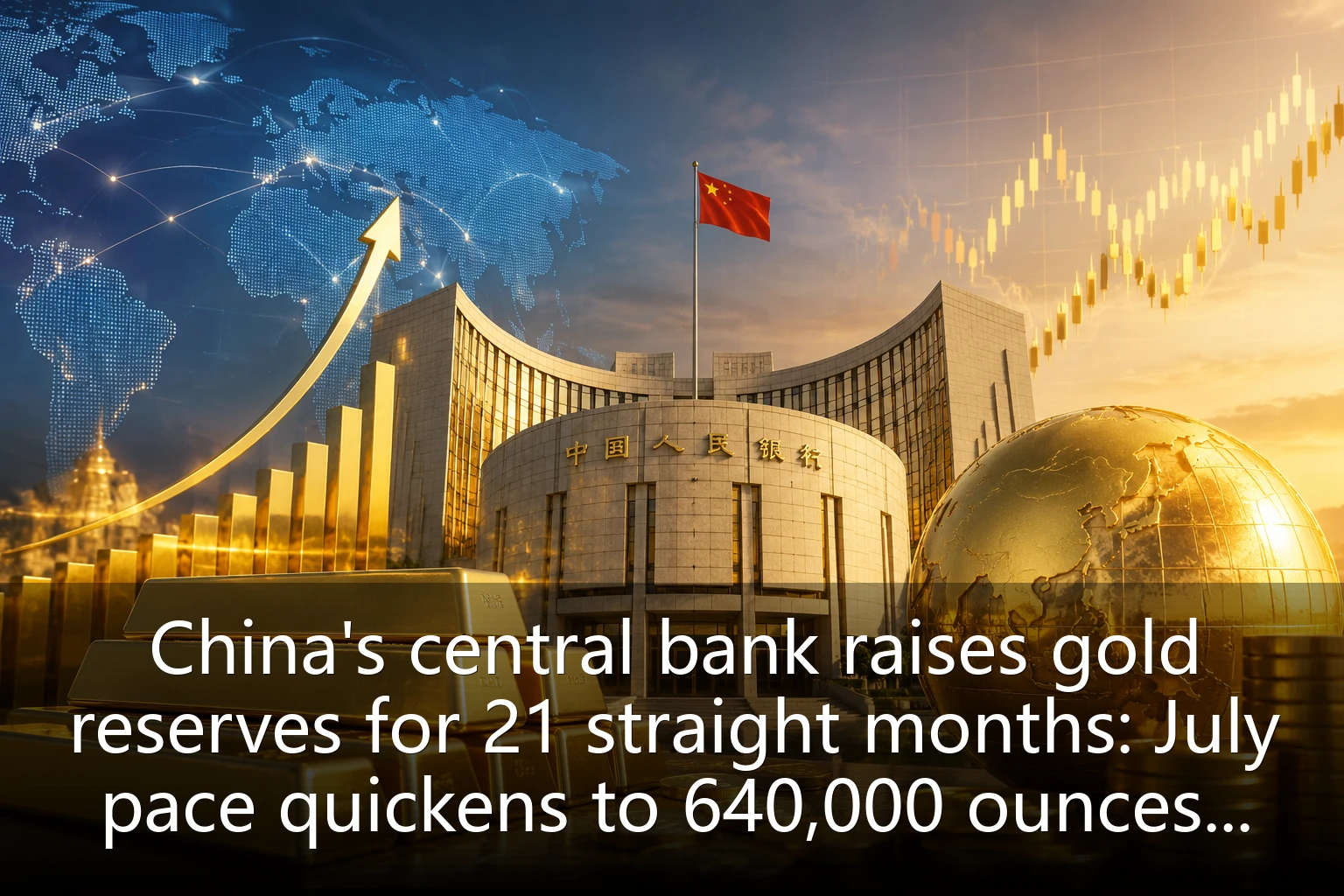
The US Dollar Index has recently hovered around the six-week low of 99.78, and the dollar has been under pressure after the joint intervention by the US and Japan in the yen exchange rate last week. Concurrently, South Korea's central bank was reported to have resumed gold allocations for the first time in 13 years, adding to the long-term trend of continuous accumulation by the Chinese central bank for 20 months, with a record monthly purchase of 480,000 ounces in June, providing solid marginal buying support for gold prices.
III. Recovery, Not a New High: Gold Prices Still More Than 20% Below Historical Peaks
It is worth noting that although gold prices rose for four consecutive trading days and returned above $4300, the current price is still more than 20% below the historical peak of $5589/ounce at the beginning of this year. Industry experts generally categorize this rise as a "recovery trend after a significant correction in the first half of the year." Visiting Professor Jing Chuan of Xi'an Jiaotong University, a veteran in the futures industry, told the media that spot gold rising above $4300 is a "reclamation of lost ground" rather than a record high. In his view, precious metals experienced three rounds of liquidity shocks in the first half of the year due to the dual pressures of the US-Iran conflict and rising interest rate expectations, with gold prices once falling below $4000 in late June. Now that the two major pressures have marginally eased, the market pricing logic is shifting from "hedging panic" back to "allocation return."
IV. Institutional Consensus is Bullish: Year-End Targets Point to $4500 to $4600
Institutions remain generally optimistic about the medium-to-long-term trend of gold prices. Michael Hsueh, a strategist at Deutsche Bank, recently reiterated that there are sufficient reasons to believe that the bottom for gold prices in 2026 has already been reached, and gold prices are expected to touch $4600 by the end of the year. UBS strategists predict that if the Federal Reserve avoids further interest rate hikes, investment demand recovers, and central banks maintain strong purchasing power, gold prices could rise to $4400 in September and $4600 in December. Citibank, meanwhile, forecasts that gold prices will climb to $4500 in the fourth quarter under the base case, with a further rise to $5000 in the first half of 2027. Domestic institutions such as Charles River Securities also pointed out that the logic of the People's Bank of China's de-dollarization gold purchases remains unchanged, and demand support will gradually return.
However, most institutions simultaneously emphasize that the upward path will not be smooth. Jing Chuan warned that whether gold prices can effectively hold above $4300 in the short term still needs to be tested by US non-farm employment, inflation data, and the Federal Reserve's policy direction—if inflation data rebounds or employment data strengthens, renewed interest rate hike expectations will put downward pressure on gold prices.
V. Mixed Signals from Consumption: Gold Jewelry is Still 20% Lower Than at the Start of the Year
On the other side of the "gold rush," the retail market shows mixed signals. Although the daily price jumps are astonishing, current brand gold jewelry prices are still about 410 to 427 yuan/gram cheaper than the historical high on January 29, representing a decline of about 24% to 25%. Based on the traditional wedding "three golds" of about 50 grams, purchasing now can still save about 21,000 yuan compared to the high point at the beginning of the year.
Some analysts point out that a sharp rise in gold prices often suppresses the willingness for physical consumption in the short term, and the daily 60 yuan jump in gold jewelry is more of a cost transmission; changes in end-market sales volume still need to be observed. For investors, the processing premium in gold jewelry makes it not an ideal investment vehicle; gold bars and gold ETFs, which have stronger investment attributes, are the main tools for tracking gold prices. For consumers with immediate needs for weddings, however, the current price still offers some cost-effectiveness compared to the high point at the beginning of the year.
VI. Future Outlook: Structural Support Remains, Volatility is the Main Theme
In the medium to long term, structural supporting factors such as global central bank gold purchases, de-dollarization trends, and high US fiscal deficits have not changed. Data released by the World Gold Council recently for the second quarter showed that global gold production reached a record high for the period, with the Polish central bank leading the increase at 51 tons, and the People's Bank of China increasing its gold reserves by 33 tons in the second quarter to 2,346 tons. The continuous gold buying by Asian central banks in the process of diversifying reserves is reshaping the global gold and silver pricing logic.
For Asian investors, short-term gold price fluctuations and long-term allocation value are not contradictory. Institutions generally advise that gold should be viewed as a "ballast" in a portfolio, not a short-term speculative tool; the pragmatic choice to navigate the precious metal cycle is to allocate in batches during pullbacks and maintain discipline during sharp rises. After all, between the $4300 threshold and the year-end target of $4600 lies every policy statement and every key data release from the Federal Reserve.
Article tags
Related Articles Recommended