
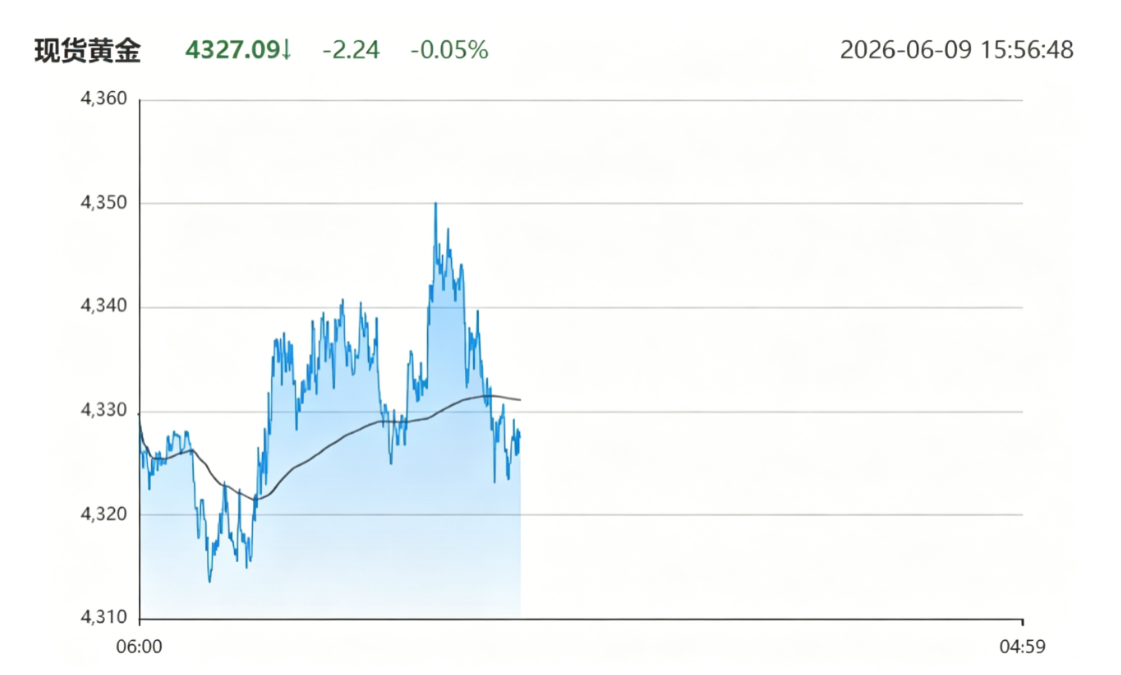
During the Asian session, spot gold extended its weakness and accelerated lower, briefly piercing the $4,300/oz round level and touching a low of $4,298.50/oz, the weakest since March 23. After breaking this key support, gold gave back most of its year-to-date gains, and market sentiment turned cautious overall.
Technically, $4,300 has now shifted from prior support to a strong short-term resistance level. If it cannot be recovered during the day, the short-term downtrend may worsen further, with the next focus on support in the $4,280-$4,250 zone.
1. Rate expectations: the core engine behind current market volatility
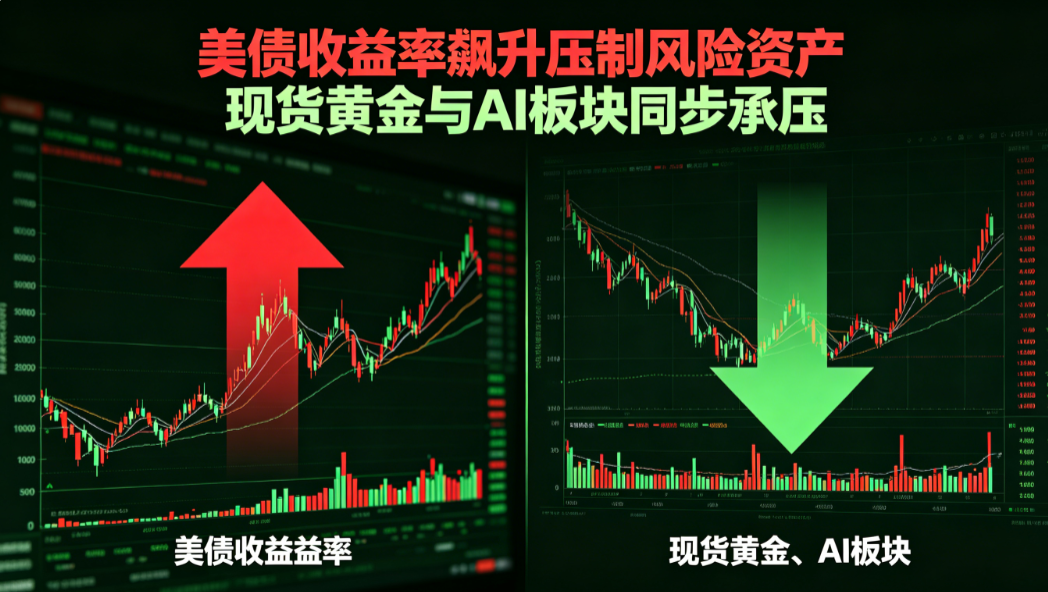
Stronger-than-expected employment data not only confirmed the resilience of the U.S. economy, but also reinforced the hawkish stance of Fed officials. Compared with the labor market, inflation risk is being given a higher priority, which directly lifted market expectations for more rate hikes.
U.S. President Trump has emphasized a 'growth' narrative on social media, which the market interprets as pressure for easier policy. But investors are more focused on the possibility of tighter policy that could follow. This expectation directly caused bonds to lose their safe-haven function and fall alongside stocks:
- Two-year U.S. Treasury yields closed at 4.160% on Friday, the highest since February 2025;
- Ten-year U.S. Treasury yields broke above 4.5%, more than 50 bps higher than before the Iran conflict;
- As a result, financing costs kept rising, and the average 30-year mortgage rate has reached 6.5%.
2. The direct victims of higher rates: gold and the AI sector
1. Spot gold: a non-yielding asset under clear pressure
On Monday morning, spot gold continued to weaken and briefly pierced the $4,300/oz level, hitting its lowest since March 23. As a non-yielding asset, gold's holding cost rises sharply when U.S. real Treasury yields keep climbing. Combined with the break below key support, short-term downside pressure is obvious.
2. AI sector: concentrated burst of a high-valuation bubble
The AI sector, which had led the market earlier, faced heavy selling. Bridgewater founder Ray Dalio warned that capital is overly concentrated in high-volatility, high-valuation emerging industries, showing classic 'bubble traits':
- The Philadelphia Semiconductor Index erased more than $1 trillion in a single week, even though it is still up 73% year to date;
- A handful of AI heavyweight stocks pushed the S&P 500 to nine straight weekly gains, leaving the market structure extremely fragile;
- Broadcom's weaker-than-expected forward guidance became the catalyst for the latest correction and also dragged South Korea's Kospi index lower.
3. Funding shock: the market's absorption power faces a major test
In the coming days, the U.S. May CPI data will become the market's new focus. Especially with energy prices still elevated, the direction of inflation data will directly affect expectations for Fed policy.
A more immediate test comes from huge primary-market financing needs:
- SpaceX is planning a record-size IPO;
- Alphabet unexpectedly announced plans to issue $85 billion in equity rather than using traditional debt financing or buybacks;
- Combined with the listing wave from AI unicorns such as Anthropic and OpenAI, massive equity issuance will directly pull liquidity out of the market.
London asset manager Arbion said: 'The market has to digest a huge amount of equity issuance, and the IPO window may close earlier than expected.' Although the labor market and chip-sector profits still provide some support, market fragility is becoming more visible under the triple pressure of high rates, valuation bubbles, and tighter liquidity.
[Latest spot gold market analysis]
At the start of the new week, gold extended Friday night's nonfarm payrolls selloff, with the late-session low touching around 4310 and basically retracing to the year's low zone. After opening this morning, price rebounded slightly from around 4310 and only managed to test the 4353 area before coming under pressure again and turning lower. The overall move fully matched the weekend review's forecast.
Last week's review had already made it clear: the early-week trend is downward overall, with $4,350-$4,353 set as the first resistance, and $4,375 as the intraday line separating strength from weakness.
From the one-hour chart, price quickly pulled back after touching $4,353 and is now trading around $4,315. Candlestick patterns show that rebound momentum is clearly insufficient, highs are stepping lower, and the short-term bearish alignment remains intact. Until gold can effectively stand above the $4,375 pivot, the overall strategy remains to sell into rebounds.