
Helen's Chinese trademarks ruled invalid, market cap plunged by more than 90%
Have you been to Helen's? This Chinese bar, once known as "young people's first bar," has recently lost its Chinese name. The Chinese trademarks "Helen's," "Helen's Tavern" and "Helen's Bigger Dapaidang" were all finally ruled invalid by the court.
But compared with merely "losing its Chinese name," Helen's bigger crisis may be that it once represented a youthful image, yet is now being abandoned by young people.
Helen's trademark defense battle: a three-year tug-of-war
Helen's was founded in 2009 and first opened in Beijing's Wudaokou area near Tsinghua and Peking Universities. Founder Xu Bingzhong is a post-70s demobilized soldier, and in the early days he mainly served the foreigner market, such as overseas students.
Perhaps for that reason, Helen's first used English trademarks such as "Helen's" and applied for a batch of related English trademarks in 2013; but its core Chinese trademarks were not registered until 2018.
According to reports, the trademark dispute over "Helen's" mainly arose between Chengdu Helen Colorful Hotel Co., Ltd. and Helen's. The other party first successfully registered two "Helen" trademarks in 2016, covering Class 43 restaurant and bar services. Then on May 23, 2023, it filed a petition with the CNIPA to invalidate the "Helen's" trademark, and on August 7, 2024, it filed another petition against "Helen's Tavern" and "Helen's Bigger Dapaidang," arguing that the disputed marks were similar to the two cited marks for similar services and could easily cause confusion about the source of the services among the relevant public.
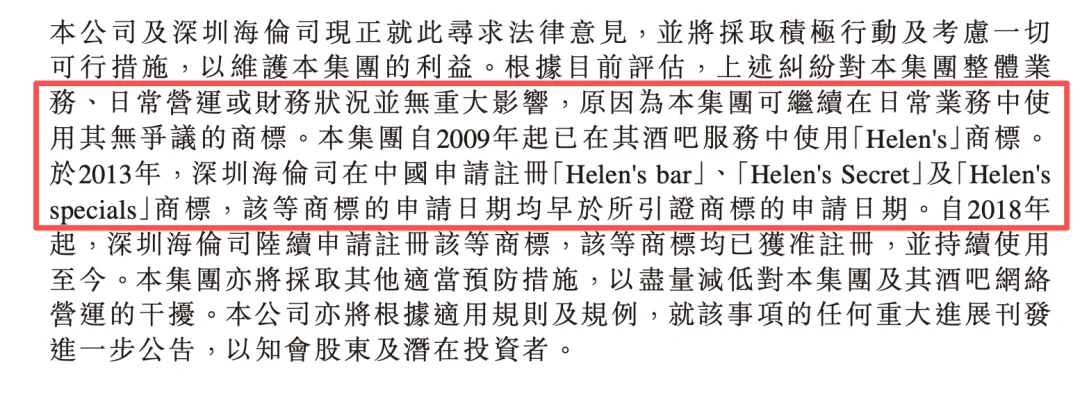
After three years of back-and-forth, on the evening of June 25 Helen's announced that the three Chinese trademarks above had been finally ruled invalid by the court. The company said that, based on current assessment, the dispute has no material impact on the group's overall business, daily operations or financial position because the group can continue to use its undisputed trademarks in day-to-day business.
Share price falls, market value shrinks by over 90%
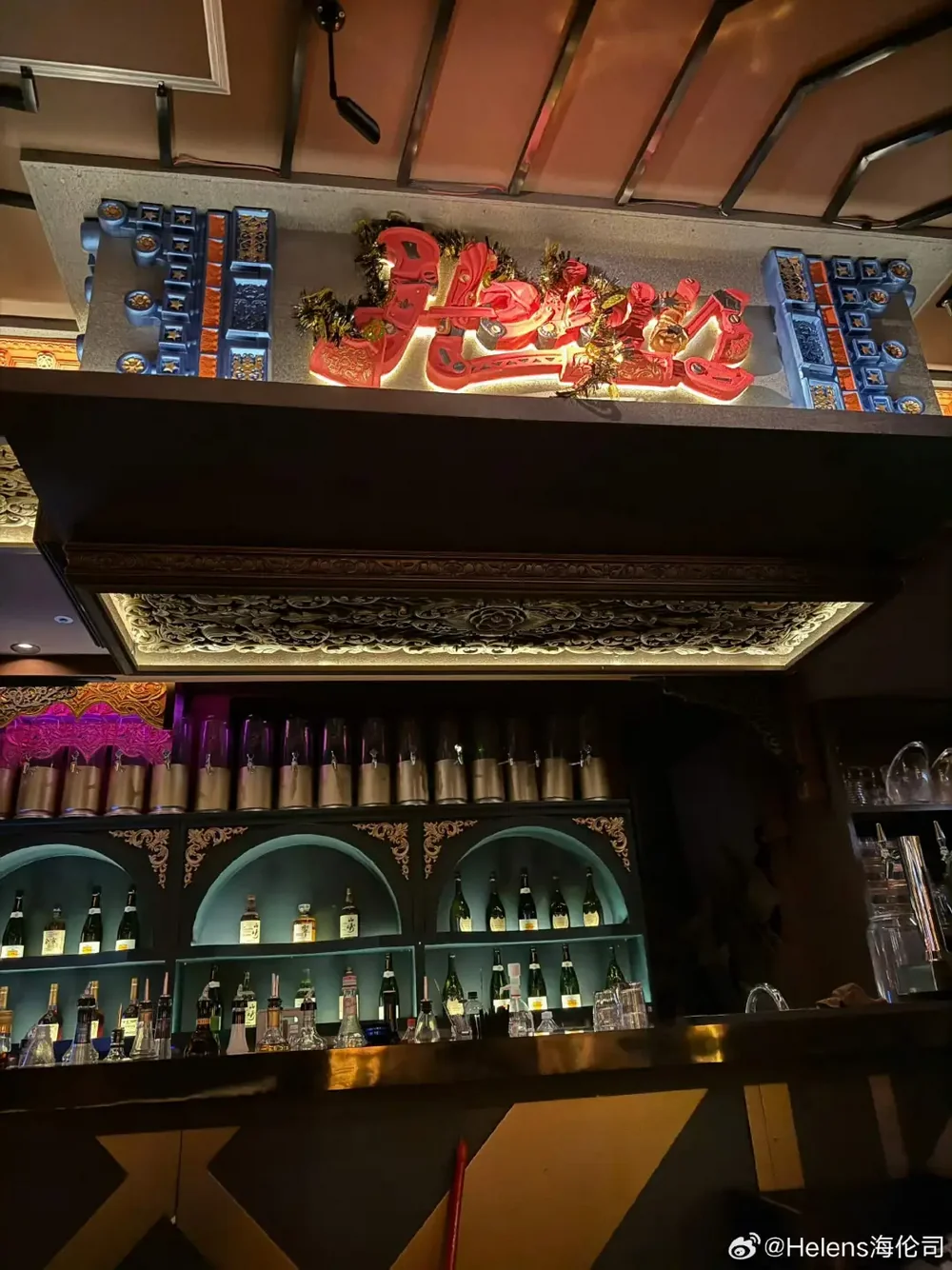
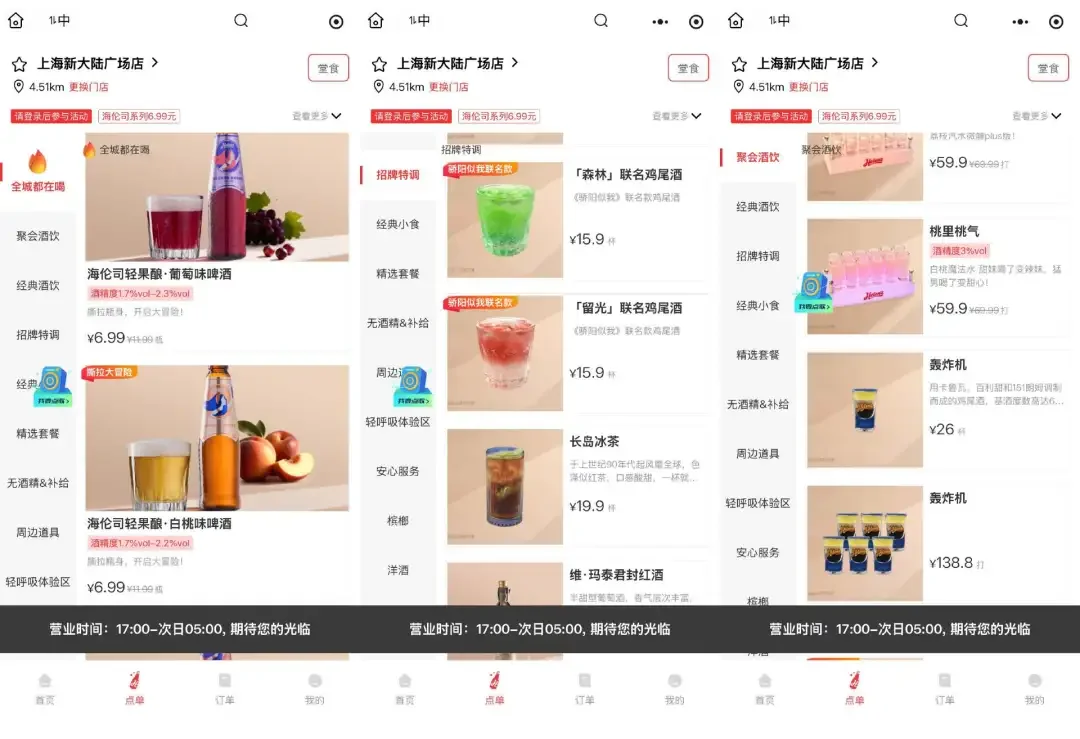
Blue Whale News found that Helen's offline stores and online promotion still use its Chinese name and related expressions. The impact has not yet spread to specific stores, but the capital market is more sensitive than physical outlets.
After the news broke, the share price opened lower on June 26 and at one point fell more than 6% intraday. By the close that day, Helen's share price had fallen to HK$1.58. Its market cap once reached HK$30 billion in the year it listed, but now it is only HK$2 billion, a drop of more than 90%.
"The first bar for young people" is no longer young: pressure from expansion and losses
Helen's earliest stores were in university districts, and its main customer base included foreigners and students. Later, founder Xu Bingzhong changed course and positioned Helen's as a space for young people to socialize offline freely, emphasizing "ultimate value for money." Helen's bottled beer sells for under RMB 10, while cocktails are a bit pricier, at just over RMB 20.
The "young people + value for money" model proved replicable. By the end of 2021, Helen's had 782 stores and listed in Hong Kong that same year as the "largest chain bar in China."
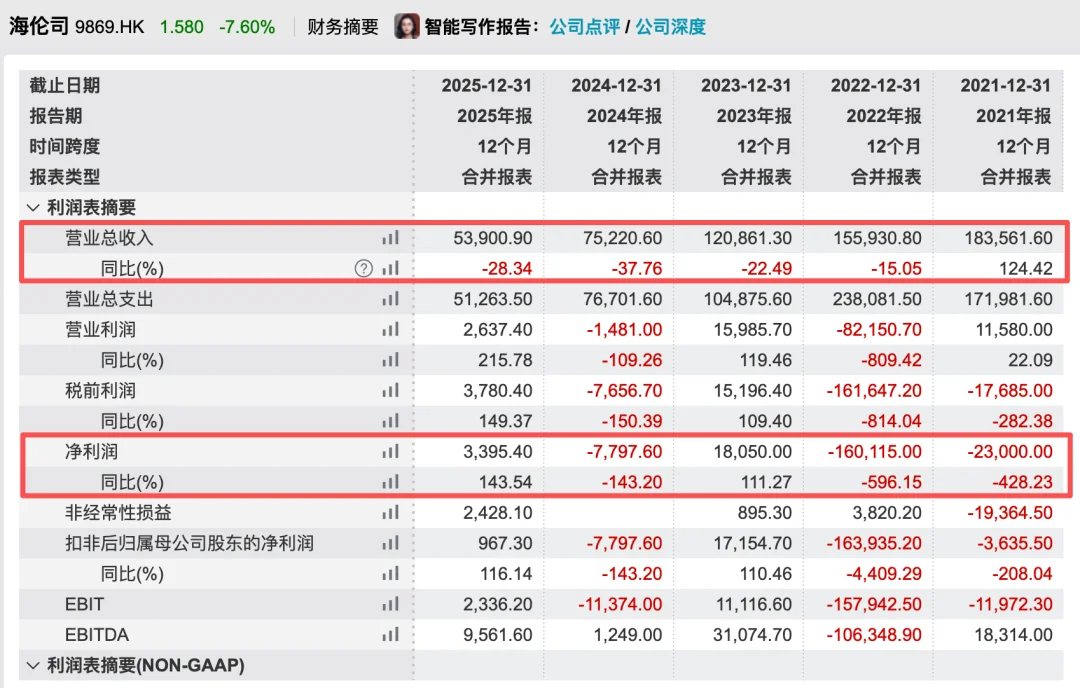
According to Helen's 2021 prospectus, revenue from 2018 to 2020 was RMB 115 million, RMB 565 million and RMB 818 million respectively; net profit was RMB 9.734 million, RMB 79.136 million and RMB 70.072 million respectively.
The prospectus showed that self-owned alcoholic beverages, with gross margins above 70%, contributed more than 60% of Helen's beverage revenue. Thanks to factory-direct procurement and economies of scale, Helen's could also get relatively favorable purchase prices for third-party branded drinks.
One advantage was scale. But while it expanded aggressively, opening costs surged. Combined with the pandemic and other factors, Helen's net loss in 2021 reached RMB 230 million, and the next year the net loss widened to RMB 1.601 billion.
After cumulative losses exceeding RMB 1.8 billion, Helen's started closing stores to save itself. Financial reports show that by the end of 2023, Helen's had 479 bars, down 288 from a year earlier and more than 40% below the peak of more than 850 stores.
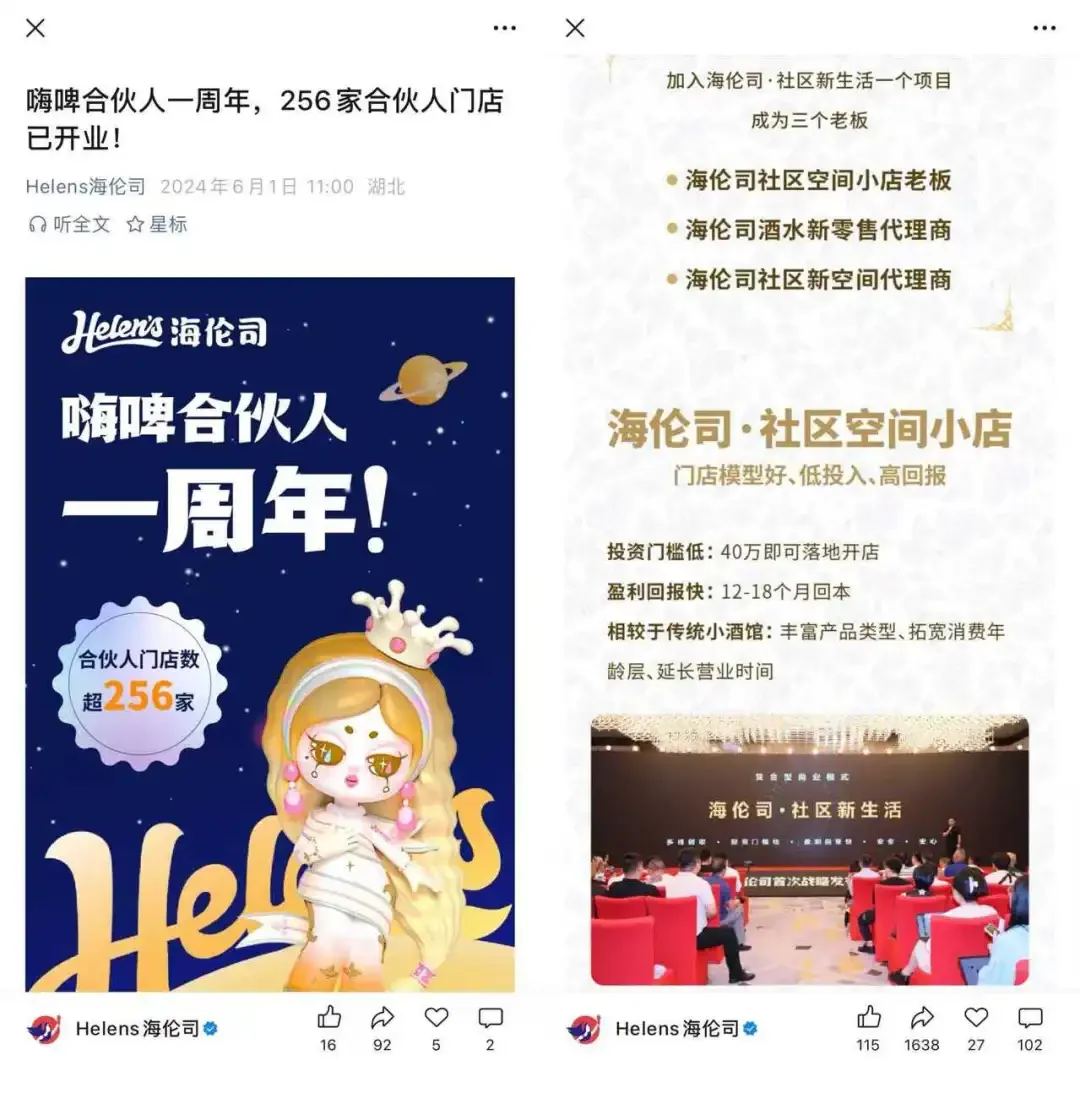
At the same time, Helen's began a strategic shift, moving from a fully direct-operations model to an open franchise model, the "Hi-Partner" plan. At launch, the minimum investment threshold was RMB 600,000; by 2024, the entry bar for the new format had been lowered to around RMB 400,000.
Bistros everywhere: Helen's business is getting harder, and same-store sales are under pressure
According to Helen's 2025 annual report, full-year revenue was RMB 540 million, down 28.3% year on year; net profit attributable to shareholders turned a profit of RMB 33.954 million. Revenue from self-owned drinks as a share of total revenue and gross margin both rose year on year, and store-level gross profit contribution rose to 73.77%, improving overall operating conditions from the prior year.
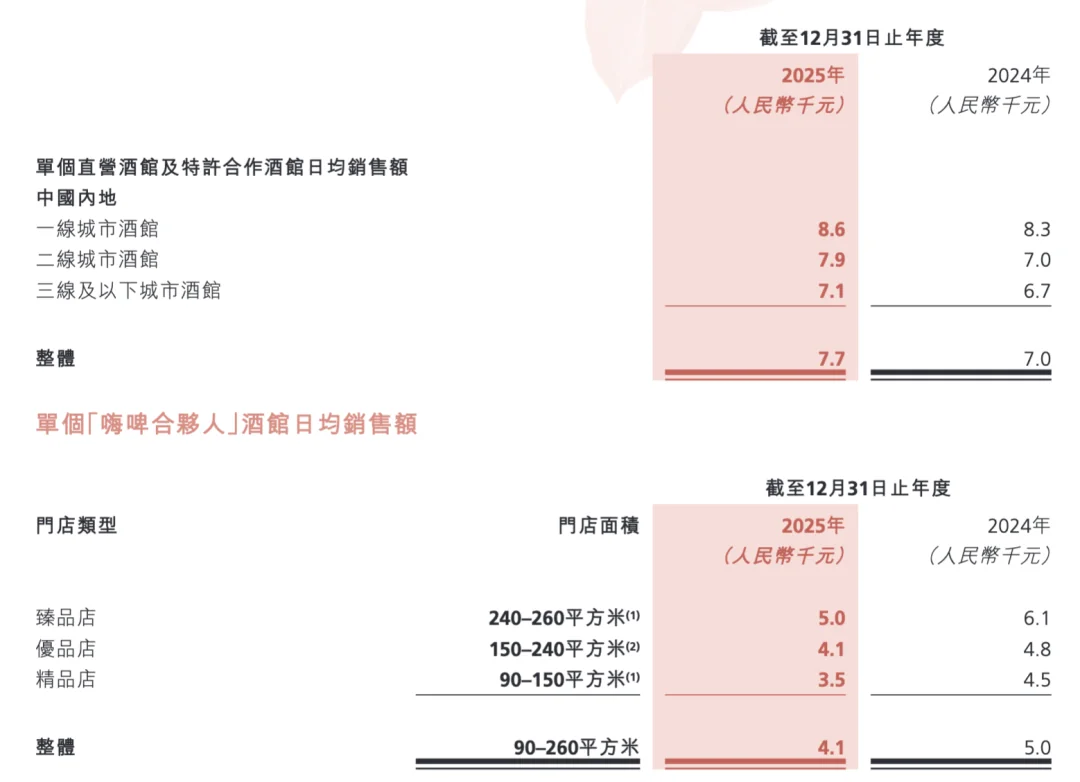
But Helen's still faces a decline in average daily sales per store. In 2025, same-store average daily sales at its directly operated and franchise-cooperation outlets were RMB 8,500, down more than 18% year on year; average daily sales per partner store were only RMB 4,100, and all store types saw declines in average daily sales.
In a catering market where daily revenue per store can easily exceed RMB 10,000, Helen's main franchise format is simply earning too little. At the same time, nearly 70% of Helen's stores are in third-tier cities and below, so profitability is objectively under pressure.
On the other side is a changing competitive landscape: there are now too many places for young people to drink, and low prices are becoming less attractive to consumers. Narrow Gate Restaurant Eye shows that 38,000 new bars opened in the past year, and consumer scenes are becoming more differentiated, from home bars, craft-beer bars and livehouse-style bars to all kinds of bistros.
Among them, bistros that combine food and drinks have risen strongly in recent years. In this segment, the brand Huanshi, which operates a "food + drinks" model, has seen rapid momentum. Its parent company Jiwusiwei filed a prospectus with the Hong Kong stock exchange in January this year. Huanshi now has more than 100 stores in China; in 2024, revenue already exceeded RMB 1 billion.
Compared with Helen's, which opened the market with low prices and scale, Huanshi has taken a different path: a more atmospheric setting, higher prices and average spending above RMB 100. On social media, one of the impressions people have of Huanshi is its "beautiful food." The prospectus disclosed that in the first nine months of 2025, its average daily sales per store were RMB 29,880.
Unlike traditional bars, Huanshi extends operating hours to more than 18 hours by offering brunch, afternoon tea, dinner and late-night drinking, improving store utilization and operating efficiency. In the first nine months of 2025, drinks and beverages contributed about 45% of revenue, 85% of which came from alcoholic drinks; gross margin stayed stable at 68.7%, above the industry average.
Still, Huanshi also faces challenges: high store costs squeeze profits, and consumer complaints about taste and food quality hurt brand reputation.
Chinese food-industry analyst Zhu Danpeng believes that, like the coffee segment, low-, mid- and high-end brands each have their own market, and the bar sector is the same. The bar format is in a period of rapid expansion, but overall concentration is still low. Perhaps after about five more years, with capital support and consumer-dividend tailwinds, the market will produce leading brands and a clearer competitive landscape.
Zhu Danpeng said product pricing is not the only key factor influencing a brand's direction. The hard-core factors for the future development of bar businesses mainly include brand effect, scale effect, fan effect, supply-chain completeness and single-store operating capability. Because each store is in a different location, strategies should also be differentiated. For Helen's, perhaps the biggest challenge is how to run every store well.